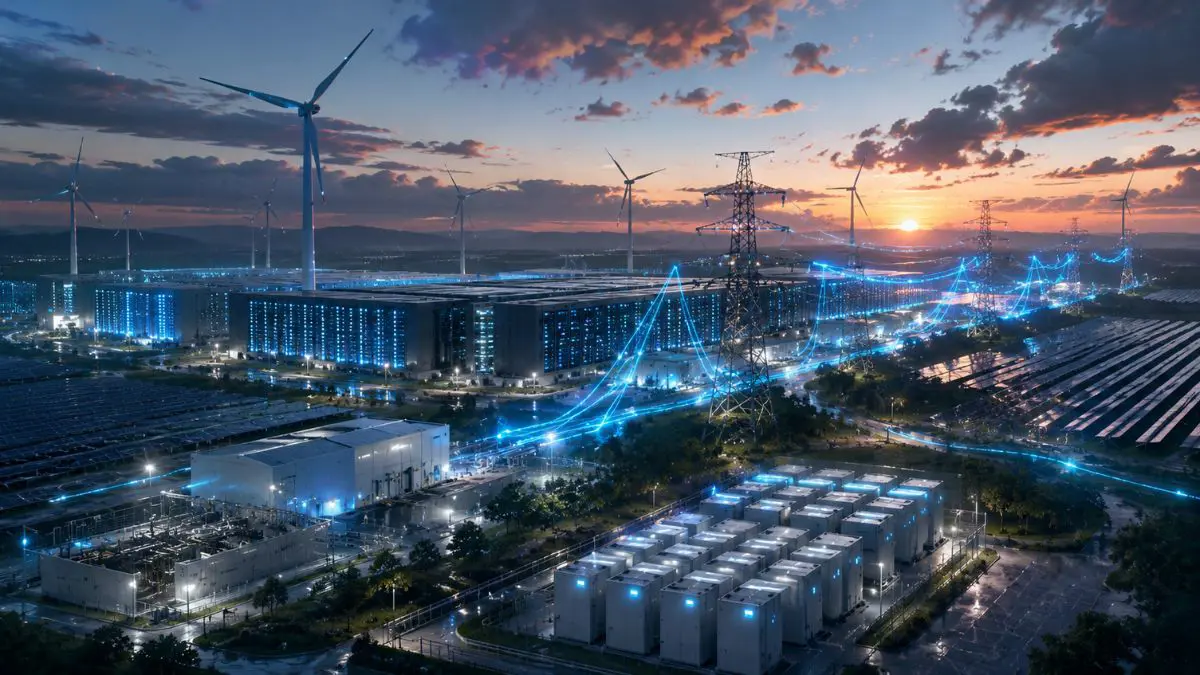
The digital revolution is about to hit a power wall. New research reveals a sobering reality: data centers constructed over the next decade could collectively consume as much electricity as India—a nation of 1.4 billion people—uses annually. This isn't just another tech industry statistic; it's a watershed moment that will reshape how we think about artificial intelligence, cloud computing, and global energy infrastructure.
The Staggering Growth Ahead
By 2035, data centers are projected to quadruple their electricity consumption compared to today's levels. This explosive growth stems from an insatiable appetite for computing power, driven primarily by the AI revolution. Machine learning models, large language models, and the infrastructure needed to support them are voracious energy consumers. Every ChatGPT query, every AI-powered recommendation engine, and every cloud-based service requires substantial computational horsepower—and that power comes at an enormous environmental and economic cost.
The numbers paint a vivid picture. India's current annual electricity consumption stands at roughly 1,200 terawatt-hours. The data centers expected to come online between now and 2033 could collectively demand that same amount of power. For context, that's equivalent to powering an entire subcontinent's worth of homes, hospitals, factories, and infrastructure.
Why the Surge Is Happening Now
Three converging forces are creating this perfect storm of energy demand. First, artificial intelligence has moved from experimental laboratories into mainstream commercial deployment. Companies are racing to build the infrastructure necessary to train and run increasingly sophisticated AI models. Second, cloud computing adoption continues its relentless expansion, with enterprises migrating workloads from on-premises servers to hyperscale data centers operated by Amazon, Microsoft, Google, and others. Third, the explosion of data itself—from IoT devices, surveillance systems, and digital services—requires ever-expanding storage and processing capacity.
The Environmental and Economic Implications
This energy trajectory poses serious challenges on multiple fronts. From an environmental perspective, data centers already account for approximately 2-3% of global electricity consumption and produce roughly 0.3% of worldwide carbon emissions. Without significant intervention, that percentage will climb dramatically, potentially derailing climate goals and complicating the transition to renewable energy sources.
Economically, the implications are equally troubling. Electricity costs represent one of the largest operational expenses for data center operators. This power surge will inflate infrastructure budgets, likely translating into higher costs for cloud services, AI applications, and digital products that consumers and businesses rely on. It may also create geographic disparities, as data center operators gravitate toward regions with cheap, abundant electricity—potentially in areas where grid infrastructure isn't equipped to handle the load.
Innovation as a Potential Lifeline
The industry isn't sitting idle. Tech giants and startups are investing heavily in solutions to address this energy crisis. More efficient chip designs, better cooling systems that replace water-intensive cooling with advanced air-based alternatives, and strategic placement of data centers in cooler climates are all part of the equation. Some companies are exploring novel approaches like liquid cooling and AI-optimized hardware architectures specifically designed to reduce power consumption.
Beyond hardware innovation, there's also a push toward renewable energy integration. Major cloud providers have committed to powering their operations with 100% renewable energy, though achieving this goal at the scale required remains a monumental challenge.
The Road Ahead
The data center energy crisis isn't inevitable—but it requires immediate, coordinated action. Policymakers need to establish frameworks that encourage energy-efficient infrastructure while supporting the transition to renewables. Tech companies must accelerate their innovation timelines and genuinely commit to sustainability goals rather than issuing aspirational statements. Consumers and businesses should demand transparency about the environmental cost of the services they use.
The next decade will be critical. The choices we make today about data center development, energy sourcing, and technological innovation will ripple through the decades to come, affecting everything from electricity grid stability to climate change trajectories. The digital transformation we've embraced comes with a power bill—and it's about to get a lot bigger.